The call that ended the plan
An asset manager at a regulated utility rated his pain a 7 out of 10 and then told me about a transformer his crew had caught days before it failed catastrophically — a save worth around four million dollars to the customers downstream of it. Exactly the story a venture wants on slide three.
Then I asked how he would actually buy something. Capital plans for the following year close in the autumn. Cyber and sourcing review runs for months before a pilot can start. Pilots themselves run six months to three years. I did the arithmetic on the call: nothing we built in 2026 could produce utility revenue before 2028.
That was one of nine conversations in a round designed almost entirely around utilities.
What the venture was
Mitsubishi Electric's US innovation center was running a venture sprint with Creative Dock, a corporate venture builder. It opened with three theses in three unrelated markets — technology for food manufacturing, virtual power plants coordinating Mitsubishi's installed smart-HVAC fleet as a demand-response resource, and remote monitoring for industrial machinery and analog gauges.
Remote monitoring won, and by the time I came in the venture had a named target: electric substations. The concept was edge AI — a camera and computer vision reading the analog pressure and temperature gauges that never got digitized, on equipment nobody is going to replace. I owned the customer research workstream from there: both ideal customer profiles, the recruiting brief and screener, four role-specific interview guides, the structure of each round, and every synthesis. I ran 23 of 28 interviews, with colleagues co-interviewing on several of those and leading the rest.
Substations are a reasonable guess. Pressure gauges are effectively never digital there, a large transmission station carries a hundred or more of them, and a technician reads each one by eye at somewhere between a hundred and two hundred dollars an hour, with a one to two percent misread rate. On a fleet inspected monthly, one to two wrong numbers per station per visit is not a rounding error. The pain is real.
The pain being real is not the same as the pain being buyable, and that distinction is what the first round was actually about.
Round One: the pain was real and the calendar wasn't
Nine conversations across four days in late April — five utility buyers, one industrial engineering leader, three consultants and advisors. Utility-heavy by design, because that was the target.
Five blockers came back, each confirmed by more than one person. Capital cycles open mid-year and lock in the autumn, so we were already too late for the next plan. Cyber and sourcing certification gates any pilot by months we had not started counting. Utility pilots run six months to three years. The strongest prospects were already funding alternatives. And at the utilities furthest along on modernization, the pain had simply stopped being felt — one substation manager rated severity a 2 and described the concept as a shortcut his engineers wouldn't want, which is a harder objection than cost.
I want to be careful about what that round found, because it is easy to overstate. It did not find that utilities don't have this problem. The 7-out-of-10 rating and the four-million-dollar save were in the same corpus as the 2. What it found was that the buying calendar put first revenue roughly eighteen to twenty-four months past where the business case assumed it would be.
The same corpus pointed somewhere else. The one industrial interviewee described a single unmonitored air-pressure gauge that cost about a hundred thousand dollars to chase down, and the Saturdays he had driven in to read gauges himself because nobody else was on site. His facility ran rounds two hours a day at a burdened rate near a hundred and five dollars an hour, seven days a week; he put it at about fourteen hundred a week himself, which is something close to seventy-three thousand dollars a year in labor for one site. Buyers in that world told me they judge against a two-year payback, which puts the ceiling for a system that replaces those rounds somewhere under a hundred and fifty thousand dollars. That is a number you can design a product against. "Eighteen months of relationship-building" is not.
So I recommended retiring the utility-first revenue plan and narrowing the next round to industrial manufacturing. That recommendation is what Round 2 was built to test.
Rounds Two and Three: testing the replacement
Round 2 ran twelve conversations over about a week — ten manufacturing buyers and two cross-segment — with transcripts for all twelve. Round 3 added five more in a single day, reaching for breadth across adjacent verticals.
Sixteen manufacturing buyers ended up in the scored cohort:
| Measure | Pain | Solution fit |
|---|---|---|
| Mean | 7.2 | 8.1 |
| Median | 7.5 | 9.5 |
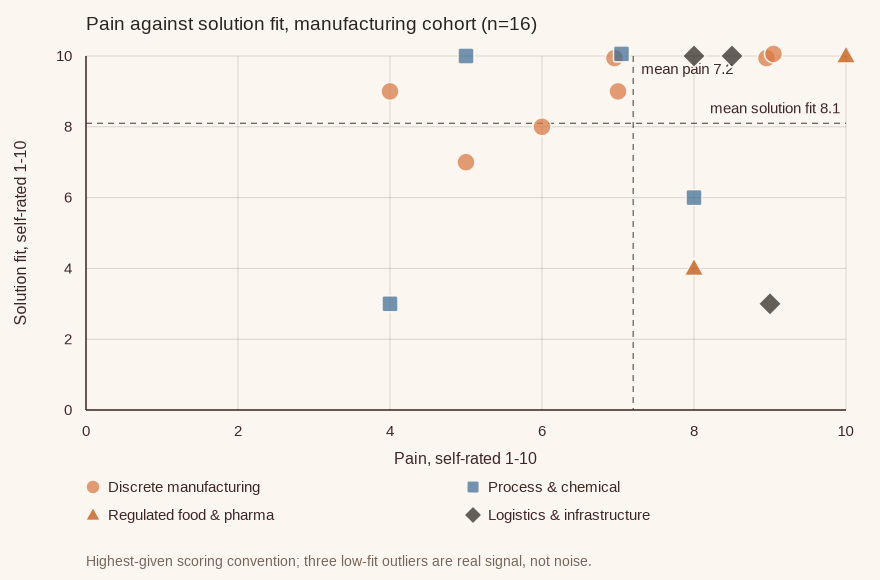
The gap between those two solution numbers is the most useful thing in the table. A median of 9.5 against a mean of 8.1 is not a spread — it is three specific people. Round 2 on its own averaged about 8.6; adding Round 3 pulled it to 8.1, and all of the drop sits with three Round 3 participants — one in regulated food production, two in heavy industry — each of whom liked the idea and doubted this version of it. Breadth cost optimism, which is what breadth is for.
The mechanics looked nothing like utilities. A thirty-day pilot was normal rather than ambitious. Pilot budgets in the five-to-fifty-thousand range cleared without a capital review. And the champion was frequently the buyer — a plant manager who could sign inside a few weeks rather than a committee that meets quarterly.
Round 3 is also where the shape of the market got more complicated than Round 2 had let on. Regulatory friction turned out to sort into four tiers, and the fourth one — FDA-validated food and pharmaceutical production — is structurally hostile to the whole motion. A maintenance lead in that tier told me he already had the readings sitting in a database and it made no difference, because it wasn't approved technology and would have to be adopted and proved. A thirty-day pilot aimed at replacing a certified record cannot work in that world. It needs to be a parallel monitoring layer that displaces nothing, which is a different product story rather than a different pitch.
The other Round 3 finding was that the same product has two completely different sales cycles depending on which buyer archetype an account fits — thirty days or eighteen months — and that sourcing has to sort for that before the first call rather than discovering it on the third.
Participants also volunteered demand for things nobody had positioned the product around: defect detection, pressure-vessel monitoring, color verification. I logged those as open questions rather than as validation. One enthusiastic mention is not a market, and the cement and precast signal in Round 2 rested on a single operator, which I flagged as n=1 in the synthesis rather than letting it read as a segment.
How the scoring worked, and what it costs
Several participants gave more than one number — a 3 today but a 7 historically, or a 9.5 personally for what was really a 10 product. I settled on using the highest score given in the headline figure and the aggregates, with the lower score and the participant's own explanation preserved in a notes column, and applied that retroactively across the cohort.
That convention is defensible and it inflates. It is a measurement of the ceiling participants could see in the concept, not of what they felt on an average Tuesday, and anyone reading 7.2 should know that. I would rather state the rule and let someone argue with it than publish a number whose construction is invisible.
The other deliberate choice was structural: the synthesis is organized around what participants said, with implications and recommendations quarantined in an appendix. Teams read strategy documents looking for the part that tells them what to do. Putting the evidence somewhere it can be read on its own terms is the only way the signal survives contact with people who already have a plan.
Where it ended
The next phase was approved. I didn't work on it — my engagement ended with the all-rounds synthesis in May, and Round 4 existed only as a sourcing design when I handed it over.
So the honest version of the outcome is that the research cleared the gate and I wasn't on the other side of it. What I know is what the work left open, because I wrote that list myself: no interview with a current semiconductor fab buyer, since the strongest industrial evidence came from one person describing a previous role; no primary conversation with anyone operating water or wastewater, which was the second-best alternative on paper and unconfirmed in practice; no internal audit of whether Mitsubishi's existing industrial accounts actually reach process-safety customers rather than assembly lines; and no documented prevented-failure story on the industrial side to match the four-million-dollar one from utilities.
That last gap is the one I'd close first. The utility save was the single most persuasive artifact in the whole corpus, and we were recommending a market where we had no equivalent.
It took three rounds to find out that the target market couldn't buy for two years, and the finding arrived in the first one. What made it findable wasn't more interviews — it was asking about the buying calendar with the same seriousness as the pain, in the round that was supposed to confirm the plan.